


Every groom reaches a point in wedding planning where the outfit decision stops feeling straightforward. The sherwani has been the default choice for Indian weddings for as long as most people can remember. But today, there are two very different directions a groom can go. A traditional sherwani carries the weight of heritage and ceremony. An Indo-Western sherwani brings a more contemporary sensibility to the same occasion. Neither is the wrong choice. They just serve different purposes, and understanding that difference is what makes the decision easier.
Indo-Western vs Traditional Sherwani: The Quick Answer
For grooms who want a direct answer on Indo-Western vs Traditional Sherwani before reading further, here it is.
- A traditional sherwani belongs at wedding ceremonies and cultural rituals. Heritage is the point.
- An Indo-Western sherwani suits receptions, cocktail events, and contemporary celebrations better.
- Timeless elegance is something traditional styling has always delivered.
- If personal expression and modern fashion feel more important, Indo-Western is the stronger direction.
The difference between Indo-Western and traditional sherwani comes down to occasion, personal style, and what the groom actually feels good wearing.
Traditional vs Indo-Western Sherwani: A Quick Comparison
| Feature | Traditional Sherwani | Indo-Western Sherwani |
|---|---|---|
| Overall Look | Heritage-inspired | Contemporary and fashion-forward |
| Best Occasion | Wedding ceremonies | Receptions and social events |
| Embroidery Style | Traditional craftsmanship | Modern detailing |
| Silhouette | Classic and regal | Structured and experimental |
| Styling | Cultural and ceremonial | Modern and versatile |
| Best for | Timeless elegance | Modern statement |
What Makes a Traditional Sherwani What it is
The traditional wedding sherwani has stayed relevant because it was never built around trends. It was built around occasions that carry real meaning, and weddings sit at the top of that list.
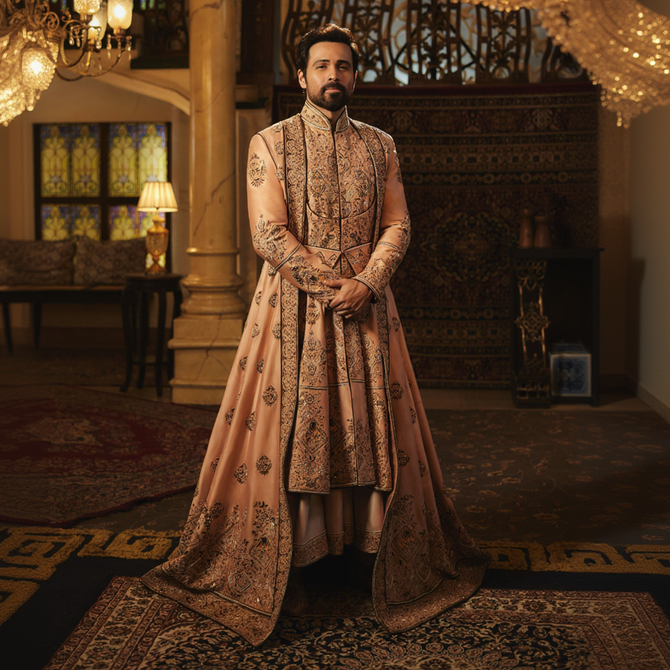
Classic silhouettes, rich fabrics, and handcrafted embroidery give a traditional sherwani its character. A royal sherwani, in particular, does something that very few outfits can. It walks into a room and commands attention before the groom says a word. Traditional sherwani with zardozi work is one of the clearest examples of this. The metallic threadwork goes into every piece over hours of handwork, and that investment shows.
For many families, the sherwani for Indian wedding groom celebrations is not really up for debate. It carries cultural significance that has been passed down through generations, and that is not something a more contemporary outfit can replicate. A sherwani for wedding occasions rooted in tradition still represents the gold standard for main ceremonies, and most experienced stylists would agree.
What Makes an Indo-Western Sherwani Different
The Indo-Western sherwani for men grew out of a genuine shift in how Indian grooms think about dressing. Not every groom wants something ceremonial. Not every venue suits heavy traditional styling. And not every wedding weekend is built around a single function.
An Indo-Western sherwani brings contemporary tailoring into the picture without abandoning Indian craft entirely. Structured cuts, asymmetric hemlines, layered styling, and cleaner silhouettes give it a modern sherwani quality that works across different settings. A designer Indo Western sherwani takes that further, with finishing details and fabric choices that feel considered rather than assembled.
Within men's wedding fashion, the Indo-Western category has grown because it gives grooms room to dress like themselves rather than dressing for an expectation. That shift is real, and the best examples of this style reflect it clearly.
Matching the Sherwani to the Function
Which sherwani you should choose often becomes clearer once the specific function is considered.
Wedding Ceremony: A traditional sherwani for wedding ceremonies is hard to argue against. The cultural weight of the occasion suits heritage styling, rich embroidery, and formal silhouettes. The main ceremony has always belonged to the classic sherwani for groom, and that has not changed.
Reception: An Indo-Western sherwani for reception events suits hotel venues and evening celebrations naturally. The atmosphere is celebratory rather than ceremonial, and contemporary tailoring reads well in hotel ballrooms and evening venues.
Sangeet: A sherwani for a sangeet function needs to allow movement. Lighter Indo-Western styles work well here because they do not restrict the groom through a long and physically active evening.
Engagement: Both directions work for engagements. The groom's personal preference usually makes the decision here more than anything else.
Choosing Based on Personality
Some grooms dress to reflect where they come from. Others dress to reflect who they are right now. A traditional sherwani suits a groom for whom heritage and ceremony feel central. An Indo-Western sherwani suits one who moves more naturally in contemporary fashion and wants versatility across multiple functions.
Where Groom Sherwani Styles Are Heading in 2026
2026 has brought a clearer sense of direction to modern groom sherwani styles. Tonal embroidery that works with the fabric rather than against it. Cleaner structure with less bulk. Traditional craftsmanship is applied with more restraint. A stronger focus on fit and comfort through long wedding days. Sherwani styles are not abandoning heritage. They are using it more intelligently.
So Which One is Actually Better
The best sherwani for the groom is not a category. It is a decision made around a specific person, a specific wedding, and a specific set of functions.
A groom's wedding dress rooted in tradition will always work for ceremonies where cultural significance leads. Indian wedding wear for men with a more contemporary finish will always work where the setting is modern, and the groom wants room to express himself. The best wedding outfit for men, whether ethnic wear for men drawn from heritage or something more fashion-forward, is the one the groom feels genuinely confident wearing. At Bharat Reshma, both directions are built to a standard that makes that confidence easy to find.