

A suit that fits well changes how you carry yourself in a room. A suit that doesn't, no matter how expensive the fabric, will always look borrowed. Most men get their suit size wrong not because they picked the wrong brand, but because they never measured properly in the first place. This men's suit size guide walks through everything from taking your own measurements to reading a size chart, converting sizes across countries, and knowing how a jacket and trouser should actually sit on your body.
Why Suit Sizing Confuses Most Men
Shirts and jeans use fairly forgiving size labels. Suits don't work that way. A jacket size is tied directly to your chest measurement, and trousers are sized by waist, so a man who wears a size 40 jacket could just as easily need a 32 or a 36 waist depending on his build. That mismatch between upper and lower body is exactly why off-the-rack suits often need alterations, and why learning how to measure for a suit yourself is worth ten minutes of your time before you buy.
Men's Suit Size Chart With Measurements
Here's a general men's suit size chart with measurements in inches. Treat it as a starting point, since body proportions vary even at the same chest size.
|
Suit Size |
Chest (in) |
Waist (in) |
Height Range |
|---|---|---|---|
|
36 |
36-37 |
30-31 |
5'6"-5'8" |
|
38 |
38-39 |
32-33 |
5'7"-5'9" |
|
40 |
40-41 |
34-35 |
5'8"-5'10" |
|
42 |
42-43 |
36-37 |
5'9"-5'11" |
|
44 |
44-45 |
38-39 |
5'10"-6'0" |
|
46 |
46-47 |
40-41 |
5'11"-6'1" |
|
48 |
48-49 |
42-43 |
6'0"-6'2" |
|
50 |
50-51 |
44-45 |
6'1"-6'3" |
This suit size chart also tends to carry a letter alongside the number, S, R, or L, which refers to your height bracket rather than your build. S is short, R is regular, and L is long. So a size 40R fits a chest of 40 inches on a man of average height, while a 40L is cut for the same chest on someone taller, with extra length through the jacket body and sleeve.
How to Measure Yourself for a Suit
Knowing how to find your suit size starts with a soft tape measure, a mirror, and a few minutes alone. Skip guessing based on your shirt or jean size; those numbers rarely translate.
Chest: Wrap the tape around the fullest part of your chest, under your arms and across your shoulder blades. Keep the tape level and don't pull it tight. This single number is what your jacket size is built around.
Waist: Measure around your natural waistline, roughly at belly button height, not where your jeans currently sit. Breathe normally rather than sucking in.
Shoulders: Measure from the edge of one shoulder to the other, across your back. This is the hardest part of a jacket to alter later, so if you're between sizes, this measurement should guide the final call.
Sleeve length: With your arm slightly bent, measure from the shoulder seam to just past your wrist bone.
Inseam: For trousers, measure from your crotch down to where you want the hem to sit, usually just above the shoe.
Once you have these five numbers, men's suit measurements become far easier to cross-reference against any chart, regardless of which country's sizing system the brand uses.
Suit Size Calculator vs. Manual Measuring
A suit size calculator can speed things up if you'd rather not do the math by hand. Most calculators ask for chest, waist, height, and sometimes weight, then return a recommended size along with a fit type, slim, regular, or classic. These tools are useful for a first estimate, but they're built on averages. If your chest-to-waist difference is unusually large or small, or if your shoulders are broader than your chest suggests, a calculator can still steer you toward the wrong size. Use it as a starting point, then confirm with your own tape measurements before you commit to a purchase.
US, UK, and EU Suit Size Conversion
If you've shopped internationally, you've likely noticed that a size 40 in one country isn't a 40 everywhere else. Here's a straightforward US to EU suit size conversion, along with UK equivalents.
|
US Size |
UK Size |
EU Size |
Chest (in) |
|---|---|---|---|
|
34 |
34 |
44 |
34 |
|
36 |
36 |
46 |
36 |
|
38 |
38 |
48 |
38 |
|
40 |
40 |
50 |
40 |
|
42 |
42 |
52 |
42 |
|
44 |
44 |
54 |
44 |
|
46 |
46 |
56 |
46 |
|
48 |
48 |
58 |
48 |
US suit sizes and UK suit size chart figures line up almost exactly, since both countries measure in inches and label jackets the same way. EU suit size conversion is where things shift; European sizing typically runs 10 numbers higher than the US or UK equivalent, since it's based on a different reference scale even though the actual chest measurement in centimeters lines up with the same body. So a US 40 and an EU 50 are cut for the same chest, just labeled differently.
Men's Jacket Size Chart and Blazer Sizing
A men's jacket size chart and a men's blazer size chart follow identical logic, since a blazer is essentially a lighter, less structured jacket. Both are sized by chest measurement, with the same short, regular, and long length options. The difference is in cut and occasion rather than sizing method, a blazer tends to sit slightly looser through the body and is often unlined or half-lined, while a suit jacket is more fitted and typically part of a matched two-piece set.
If you already know your jacket size, you know your blazer size. The one adjustment worth making is checking sleeve length separately, since blazers are sometimes worn slightly shorter in the arm depending on current styling trends.
Suit Fitting Guide: How Each Part Should Sit
A suit fitting guide isn't just about the number on the tag, it's about how the garment behaves on your body once it's on.
Shoulders: The seam where the sleeve meets the jacket should sit right at the edge of your shoulder bone. If it hangs past your shoulder or pulls inward, no tailor can fix that without remaking the jacket, so get this right at the point of purchase.
Chest and torso: You should be able to slide a flat hand between your chest and the buttoned jacket. Any tighter and the fabric will pull; any looser and the jacket will look boxy.
Sleeve length: The jacket cuff should end where your wrist meets your hand, allowing about half an inch of shirt cuff to show underneath.
Jacket length: The bottom hem should roughly line up with the curve of your palm when your arms hang naturally at your sides.
This covers how should a suit jacket fit in practice, and it's worth trying on a jacket while standing, sitting, and reaching forward, since a suit that only looks good standing still isn't doing its job.
For trousers, how should suit trousers fit comes down to three checkpoints: the waistband should sit comfortably without a belt cinching it tight, the seat and thighs should have room to move without pulling, and the break at the ankle should be minimal, just a slight fold where the fabric meets the shoe, rather than pooling at your ankle.
Choosing the Right Suit Size When You're Between Sizes
Learning how to choose the right suit size gets trickier when your measurements fall between two numbers on a chart. The general rule is to size up rather than down. A jacket that's slightly loose can be taken in at the waist and sleeves by a tailor, but a jacket that's too tight through the shoulders or chest usually can't be let out enough to matter. Trousers follow the same logic, since a waistband can be adjusted inward more easily than let out.
When Off-the-Rack Isn't Enough: Custom Tailored Suits
Even with accurate measurements, standard sizing assumes an average build, and plenty of men simply don't fit that average. If you have a noticeably long torso, uneven shoulders, or a chest-to-waist difference well outside the typical range, custom tailored suits solve a problem that no size chart can. Every measurement, from shoulder slope to trouser rise, is built around your actual body rather than a standard template, which is why a well-made custom suit tends to need little to no alteration once it arrives.
Designer Wedding Suits for the Groom
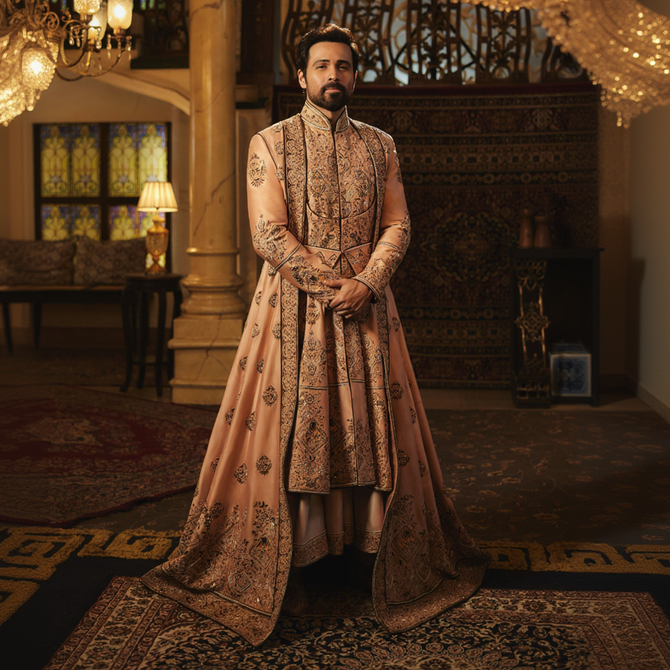
A wedding is one of the few occasions where fit truly can't be an afterthought, since you're standing in front of every camera in the room for hours. Designer wedding suits for groom wear typically lean toward richer fabrics, structured shoulders, and finer detailing on the lapel and buttons compared to everyday suiting. Indo-Western silhouettes, bandhgala jackets, and tailored sherwani-suit hybrids have become popular choices for grooms who want something formal but distinct from a standard business suit.
Whether you're going traditional or contemporary, the same fitting principles apply. A wedding suit that's cut slightly loose will show in every photograph, so it's worth getting measured properly rather than relying on your usual off-the-rack size, especially if you're renting or ordering months in advance and your body could change slightly before the date.
Designer Suits for Men Beyond the Wedding
Outside of weddings, designer suits for men cover everything from formal business wear to evening event pieces. The sizing principles stay the same regardless of the occasion; what changes is fabric weight, lining, and detailing. A well-fitted suit works across settings because the fit itself, not the price tag, is what makes it look intentional rather than off-the-shelf.
Final Word
A suit measurement guide only matters if you actually use it before you buy. Take your own measurements, cross-check them against a size chart or calculator, and don't skip the shoulder and chest fit checks once the jacket is on. Whether you're buying ready-to-wear, going custom, or shopping for a wedding, getting the size right the first time saves you the trip to a tailor later and makes sure the suit does what it's supposed to do, make you look like you belong in it.